Resources

UNSC Briefs
Informal briefing by the Abductees' Mothers Association to members of the Security Council, July 2020

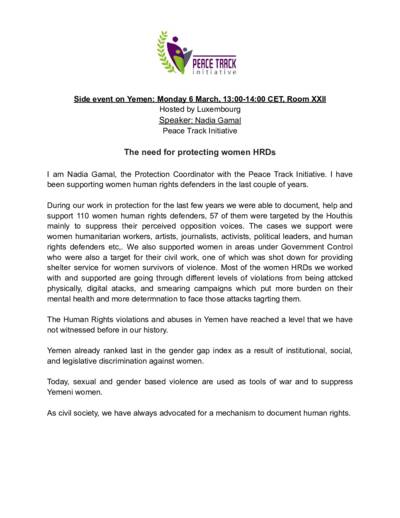
On July 30, 2020, Peace Track Initiative (PTI), in collaboration with the Mothers of Abductees Association and Food for Humanity, delivered a powerful statement at a United Nations Security Council (UNSC) meeting through the voice of Dr. Amat Al-Salam Al-Hajj. Representing the Women Solidarity Network, Dr. Al-Hajj highlighted the plight of detainees in Yemen, including women, and the broader humanitarian crisis aggravated by war, COVID-19, and systemic aid failures. The statement emphasized three core concerns: the urgent need to release arbitrarily detained civilians, the catastrophic impact of the humanitarian crisis exacerbated by the pandemic and floods, and the exclusion of women from peace processes. It also called for meaningful inclusion of women—no less than 50%—in all peace and humanitarian efforts, and for flexible funding to women-led organizations. PTI stands committed to amplifying the voices of Yemeni women and grassroots actors for peace, justice, and human dignity.The Statement was delivered during the event: “On the Frontlines: The impact of the Yemeni conflict on the rights of women and children” a Roundtable organized by the UK Mission.  

Publication
Will the Joint Declaration lead to a ceasefire or a continuation of hostilities?

An analysis of the Joint Declaration draft for ending the war in Yemen, as proposed by the Office of the Special Envoy of the Secretary General for Yemen (OSESGY)   In this document, the Peace Track Initiative team seeks to conduct a comparison of the ceasefire draft proposals by the Office of the Special Envoy of the Secretary General for Yemen (OSESGY) and the Houthi Group’s (Ansarullah) proposal for ending the war in Yemen, which were proposed in April, as well as, the recent draft of the joint declaration. While the analysis aims at understanding the positions of all the parties involved, the government’s position could not be underlined, as it has not announced it in detail. It is worth-mentioning that OSESGY has not held consultations on the draft of the Joint Declaration and has not officially shared it with the civil society entities, including women and youth. Instead, we have obtained the drafts in an unofficial manner from more than one reliable source. Therefore, in support of a peace process that adheres to the principles of accountability and inclusive national participation, we have decided to publish these drafts.  

Publication
A lexicon on hate speech in Yemen

PeaceTech Lab, Peace Track Initiative, and Development Transformations have partnered to produce “Yemen: A Lexicon of Hate Speech Terms” which is a tool that stakeholders can use to identify and curb the use of specific hate speech terms on Yemen’s social media platforms to help bring an end to violence.

UNSC Briefs
Our partner and Women Solidarity Founding MUNA Luqman Briefed the UNSC in April 2019.

Muna Luqman, co-founder of Food4Humanity Foundation and a leader of the Women’s Solidarity Network, delivered a compelling address to the UN Security Council, shedding light on the brutal realities of the war in Yemen and the systematic exclusion of women from peace processes. As both a survivor and a peacebuilder, Luqman shared heartbreaking firsthand accounts of airstrikes, sieges, and the weaponization of hunger—while condemning the failure of the Stockholm Agreement to address gender justice or include the voices of women. Luqman’s testimony exposed the hypocrisy of a peace process that rewards armed actors while sidelining grassroots women mediators who negotiate local ceasefires, secure the release of prisoners, and deliver aid across frontlines. Despite their pivotal roles, women remain absent from formal negotiations, with crucial issues such as sexual violence, child recruitment, and the Southern question being ignored. The statement also highlighted the complicity of the international community, including the Saudi-led coalition’s blockade and Houthi restrictions on aid, which have exacerbated the humanitarian catastrophe."We are not just victims of this war—we are peacebuilders. Yet our voices are mocked while those who wield weapons are rewarded." —Muna Luqman The document concludes with seven concrete demands: an immediate ceasefire, local peace agreements, 50% women’s representation in peace talks, and accountability for war crimes. This urgent appeal remains a rallying cry for inclusive peace, reminding the world that sustainable solutions in Yemen are impossible without women at the table.