Resources

Data
The 2018 Pre-session UPR Joint Submission

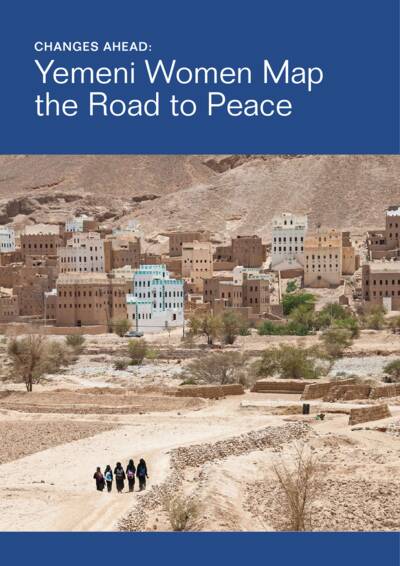
Peace Track Initiative and partner organizations, "Changes Ahead: Yemeni Women Map the Road to Peace" is a groundbreaking report that amplifies the voices of Yemeni women amid one of the world’s worst humanitarian crises. Developed collaboratively by six Yemeni human rights organizations and the Women’s International League for Peace and Freedom (WILPF), this document exposes the gendered impacts of the conflict—from sexual violence and child marriage to the exclusion of women from peace processes—while charting a feminist path forward. The report builds on Yemen’s 2018 Universal Periodic Review (UPR) submission, "Women and Girls Paying the Heaviest Price in Yemen," and provides stark evidence of how war has deepened pre-existing inequalities. With 22.2 million Yemenis in need of humanitarian aid, women bear disproportionate burdens: 76% of displaced persons are women and children; child marriage has surged by 66%; and women remain systematically excluded from political decision-making despite their frontline roles in local mediation and humanitarian response. Structured around seven thematic chapters, the report combines data, survivor testimonies, and actionable recommendations. It calls for an end to arms transfers fueling the conflict, demands 30% women’s representation in peace talks, and urges legal reforms to protect women’s rights. This publication is a vital tool for advocates, policymakers, and international actors committed to a just and inclusive peace in Yemen.
UNSC Briefs
Peace Track initiative director brief to the UNSC on the situation in Yemen, November 2018

On 16 November 2018, Rasha Jarhum, Director of the Peace Track Initiative, delivered a compelling address to the UN Security Council on behalf of more than 250 Yemeni women leaders and organizations advocating for peace and women's rights. The statement highlighted the devastating humanitarian consequences of the conflict in Yemen, including indiscriminate airstrikes, landmines, sexual violence, and the systematic exclusion of women from formal peace processes. Jarhum emphasized the contradiction at the heart of international mediation efforts, where armed actors are rewarded with a seat at the table, while grassroots peacebuilders—particularly women—are sidelined. Despite playing key roles in brokering local ceasefires, organizing humanitarian evacuations, and negotiating the release of detainees, Yemeni women remain excluded from official negotiations. The statement also criticized the international community for its complicity—through continued arms sales, restrictive migration policies, and insufficient funding for humanitarian aid that addresses women's needs. The statement concluded with 24 actionable recommendations, including an immediate ceasefire, inclusive political negotiations, accountability for war crimes, and ensuring at least 30% representation of women in all peace structures. This statement continues to serve as a vital advocacy tool, reinforcing the message that sustainable peace in Yemen cannot be achieved without full and equal participation of women.    

Publication
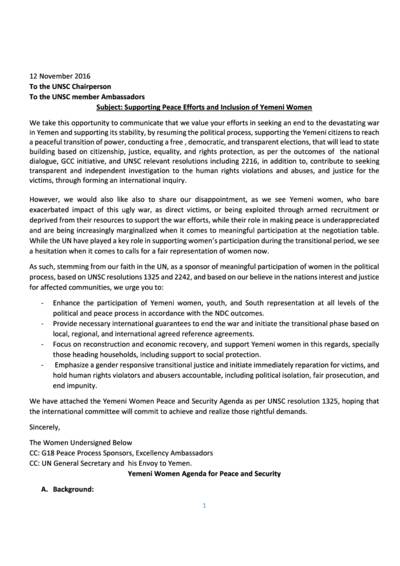
Yemen WPS National Agenda for 2016

I In 2016, over 70 Yemeni women leaders collaborated to develop the Yemeni Women’s Agenda for Peace and Security (WPS National Agenda)—a policy-oriented document outlining key recommendations for inclusive peace, justice, and post-conflict recovery in Yemen. Addressed to the UN Security Council, peace process facilitators, and international actors, the agenda proposes a 30% quota for women’s participation, the protection of women and girls from gender-based violence, disarmament initiatives, economic inclusion, and transitional justice mechanisms that consider gender dimensions. It also underscores the importance of integrating the needs of women and children into peace negotiations, humanitarian aid, and reconstruction plans, in line with UN Security Council Resolutions 1325 and 2242. Recognized by the UN Security Council in June 2017, the agenda remains a reference point for efforts aimed at achieving inclusive and lasting peace in Yemen. The full document outlines Yemeni women’s contributions to peacebuilding and efforts toward gender equality.